- exercises
- if difficult topic: recap
- if "simple" topic: solving exercises together in class
100% oral exam
Exercises
-> HS2026_tasks
| Serie | Lösung | Korrektur |
|---|---|---|
Vorlesung
4. Stellar Evolution
#timestamp 2026-09-21
- Mass-Luminosity Trade-off: More massive stars burn hydrogen faster and die much sooner.
- Nuclear Fusion: Core hydrogen fuses into helium via the
chain (low mass) or CNO cycle (high mass).
Low to Intermediate Stars (
-> Evolution: Main Sequence
- Helium Flash: Stars below
develop a degenerate helium core. Core helium ignition occurs explosively once temperatures rise enough. - Final Remnant: Planetary nebula ejects the outer layers, leaving behind a Carbon-Oxygen White Dwarf held up by electron degeneracy pressure.
Massive Stars (
-> Evolution: Main Sequence
- Onion-Skin Burning: Successive core/shell burning stages grow shorter and hotter:
- The Iron Boundary: Fusing Iron (
) absorbs energy rather than releasing it. - Core Collapse: When the iron core reaches the Chandrasekhar limit (
):
- Photodisintegration breaks iron nuclei.
- Electron capture (
) neutralizes protons. - Outer layers collapse onto the dense core, bounce off, and trigger a Type II Supernova.
- White Dwarf: Supported by electron degeneracy pressure (
). - Neutron Star: Supported by neutron degeneracy pressure (
). - Black Hole: TOV limit exceeded; gravity overwhelms all degeneracy pressure (
).
| Star Mass (M) | Core Ignition | Final Burning | Remnant Type |
|---|---|---|---|
| None | None | Brown Dwarf | |
| Hydrogen | Hydrogen | He White Dwarf (Hypothetical) | |
| Helium (Flash) | He / C-O | C-O White Dwarf | |
| Full Chain (Fe) | Silicon |
Neutron Star | |
| Full Chain (Fe) | Silicon |
Black Hole |
5. Galactic structure
- Central bulge, bar: Central, rounder galaxy region. Ranges from a spherical "classical" bulge to a flattened "pseudo-bulge" or bar. dominates galactic dynamics within a few
of the center. Surface-brightness profile well represented by a Sérsic profile - Galactic Disk: A flattened structure extending radially from the center containing stars and gas. Its radial light distribution generally follows an exponential profile
- Stellar Halo: A surrounding structure containing stars and globular clusters. Contains relatively little mass (e.g.,
in the Milky Way), but acts as a tracer population where dark matter dominates - Dark Matter Halo: A vast, surrounding halo of dark matter that dominates the total mass profile and dynamics of the galaxy at larger radial distances (
).
6. Active Galactic Nuclei (AGN)
-> main point: different classes of AGNs are fundamentally the same physical system viewed from different angles/having varying jet activity
components
- Central Supermassive Black Hole (SMBH): A black hole with,
, drives the system via matter accretion - Broad-Line Region (BLR): Fast-moving gas clouds close to black hole (
), emitting broad emission lines due to high-velocity orbital motion - Narrow-Line Region (NLR): Slower-moving gas clouds located further out from the central engine -> narrower emission lines
- Dusty Torus: A doughnut-shaped ring of thick dust and gas surrounding the inner regions (accretion disk and BLR). Depending on the line of sight, this torus obscures the central engine and BLR
- Relativistic Jets: Collimated outflows launched perpendicularly to the accretion disk.
The unified model posits that different observed classes of Active Galactic Nuclei (AGN) are fundamentally the same physical system viewed from different angles or possessing varying degrees of jet activity.
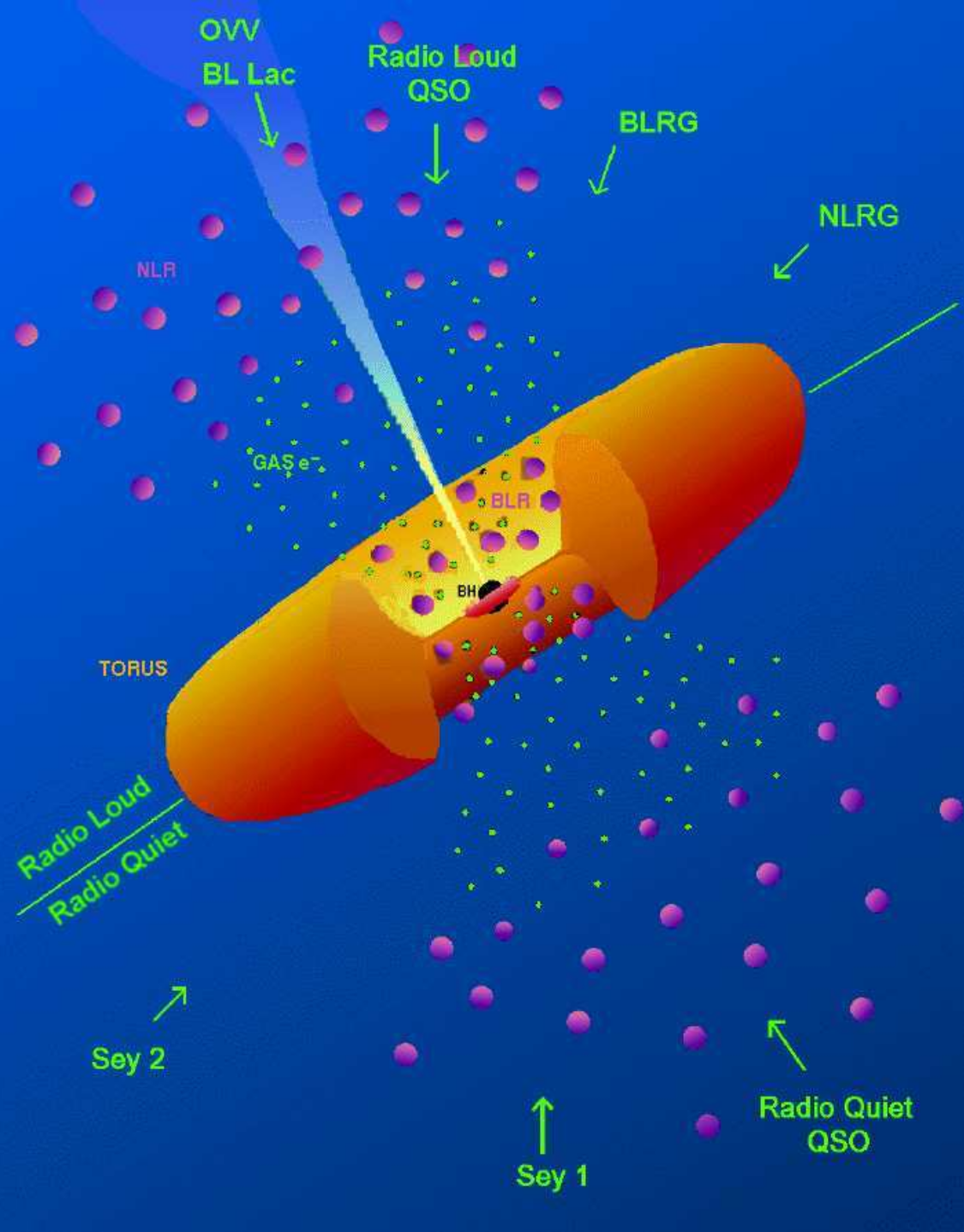
| orientation | explanation | classification |
|---|---|---|
| unobscured (face-on) view | looking down the opening of the dusty torus; BLR and NLR visible | - seyfert type 1 - QSOs |
| obscured (edge-on) view | dusty torus blocks line of sight to center; only NLR visible | - seyfert type 2 - NLRGs |
| line-of-sight alignment (Blazars) | looking directly down the axis of the relativistic jet; large variability | - OOV - BL Lac |
- BL Lac = blazars
- OVV = optically violently variable
- BLRG = broad-line radio galaxy
- NLRG = narrow-line radio galaxy
- Sey 1= Seyfert type 1 (broad emission lines visible)
- Sey 2 = Seyfert type 2 (only narrow emission lines visible)
All AGN's are (could be) the same model, looked at either from the side (central black hole hidden) or from the top (torus, black hole visible). If the view is directly centered on the jet, we get Blazars (strong emissions)
-> perspective determines AGN type
| Radio-strong | Radio quiet |
|---|---|
| strong jet | weak / no jet |
| radio-loud QSOs, BLRG, NLRG, Blazars |
Seyfert 1&2, Radio-quiet QSOs |
7. EXTRA: EBL
Extragalactic Background Light (EBL) is the accumulated diffuse radiation emitted throughout the history of the Universe by extragalactic sources, primarily driven by star formation (nucleosynthesis) and active galactic nuclei / black holes (gravitation). Total EBL is equivalent to
- Absolute EBL/CIB measurements are difficult due to local foregrounds like zodiacal light and Galactic dust/cirrus
A faint, triangle-shaped glow in the night sky that is caused by sunlight reflecting off interplanetary dust
| Spectrum Component / Waveband | Primary Integrated Brightness (nW⋅m−2⋅sr−1) PDF | Key Sources & Physical Drivers PDF |
|---|---|---|
| Cosmic Microwave Background (CMB) | Thermal blackbody radiation ( |
|
| Cosmic Infrared Background (CIB) | Dust emission, star formation, and energy production history post-recombination. Note that |
|
| Cosmic Optical Background (COB) | Direct starlight and optical emission from distant galaxies. | |
| X-Ray Background (XRB) | High-energy emission from AGN, accreting black holes, and Seyfert galaxies. Peak energy is around |
|
| Gamma-Ray Background (GRB) | Diffuse high-energy emission driven largely by blazars (FSRQs and BL Lac objects). | |
| Radio Background | Low-frequency synchrotron and non-thermal emission from radio-loud extragalactic sources. |